Thursday, July 26, 2012

Navigating the Rogue River by Steamer

In 1878 the United States Congress ordered a study be done to determine the feasibility of using a steamship to ferry passengers and goods from Grants Pass to the Pacific ocean.

The following is an excerpt of a news item that appeared in Jacksonville's "Democratic Times."

Colonel Gillespie, United States Engineer in charge of river and harbor improvements, has detailed Philip G. Eastwick as assistant and assigned him the duty of making a preliminary survey of Rogue River from Grants Pass to the sea.  From a letter received by C. C. Beekman of this place we learn that Mr. Eastwick is now at the starting point of his survey, making preparations to start down the river as soon as he can secure a suitable craft and a competent boatman.  He thinks he will be able to perform the task assigned him in about twenty days.  If it is found the river can be rendered navigable for small steamers by the construction of locks and dams, the government would doubtless make, in due time, an appropriation to construct such works.  It is not at all improbable that in the near future, those who reside along the margin  of the River that courses through our valley to the sea may be startled by the shrill voice of the steamwhistle.

As you can imagine, Mr. Eastwick quickly found the Rogue to be unnavigable for steamers.  75 miles before he reached the mouth of the Rogue, his boat and all its contents were lost in some rapids.  From there he walked 44 miles until he reached the mouth of the Illinois River where he was able to find a small boat to take him the remaining 31 miles to Ellensburgh (Gold Beach).  

A complete account of Mr. Eastwick's adventure can be read at: Google Books.

Friday, July 20, 2012

Promises and pie-crust are made to be broken - Jonathon Swift

“Promises and pie-crust are made to be broken.” - Jonathon Swift
 It's almost time for the Josephine County Historical Society's Pie Contest!

The judging will take place on July 27th at the Schmidt House Barn located at 508 SW 5th Street in Grants Pass, OR.
If you would like to enter, and I hope you do, you can download the registration form here.   Your entry form and pie (in a disposable container) must be brought to the Schmidt House Barn by 11:00AM on July 27th.

“Unless you're an avid pie maker you don't really need 20 pie plates.” - Barry Izsak

Last year, I submitted a peach cobbler for my entry.  I thought that was rather fitting for a historical society since our ancestors that came west along the Oregon, California and Mormon trails would have made cobblers rather than pies during the journey since pies require a traditional oven for baking, but cobblers and crisps turn out wonderful in dutch ovens.

Well, I didn't win, place or show -- so this year I'm making a "filled pie."  I do have my mother's pie crust recipe that she got from her mother who got it from her mother.   I didn't have much luck with it.  The crust went into my pie plate looking like a jigsaw puzzle.

I started looking through recipe books, both printed and online; I'm amazed at how many different recipes there are for pie crust.  Some call for shortening, others for butter, some for both.  I found a few that needed vinegar, one that called for heavy cream and another for vodka.  I've tried about eight of them, and I've finally found the one that works best for me.  Guess what, it's my great grandmother's recipe with a couple of changes; I've substituted Crisco shortening kept in the freezer overnight for the lard and added a tablespoon of sugar.


Now on to the filling.  I tried strawberry, blueberry, blackberry, black and blue, raspberry, and pear.  The strawberry required refrigeration, so it won't qualify; raspberries are just too expensive, and mine didn't thicken (although it was the tastiest); the spices in the black and blue didn't taste right to me (cloves and nutmeg); the pear pie had to be eaten with a knife and fork - I still don't understand why those pears were so tough.

I had such high hopes for this "black and blue" pie; it's the prettiest one I've ever made.

“I prefer Hostess fruit pies to pop-up toaster tarts because they don't require as much cooking.” - Carrie P. Snow

I've eaten a lot of pie in the past six weeks.  Six generous sized pieces of pie six days a week for six weeks.


“We just want a piece of the pie. That's all.” - Tim McKee


There is only a week before the contest and I'm still wondering what kind of pie to make.  Maybe I'll try a peach cobbler!

“You can wipe out a workout with a glass of milk and a piece of pie.” - Joe Donnelly

Tuesday, July 17, 2012

Hike to Onion Mountain Lookout - Josephine County, Oregon


Last week, we took a nice hike to the Onion Mountain Lookout Tower.  This is the third lookout station to be placed on the top of Onion Mountain.  The first tower was built in 1916 and replaced in 1924.  This tower has been here since 1952.

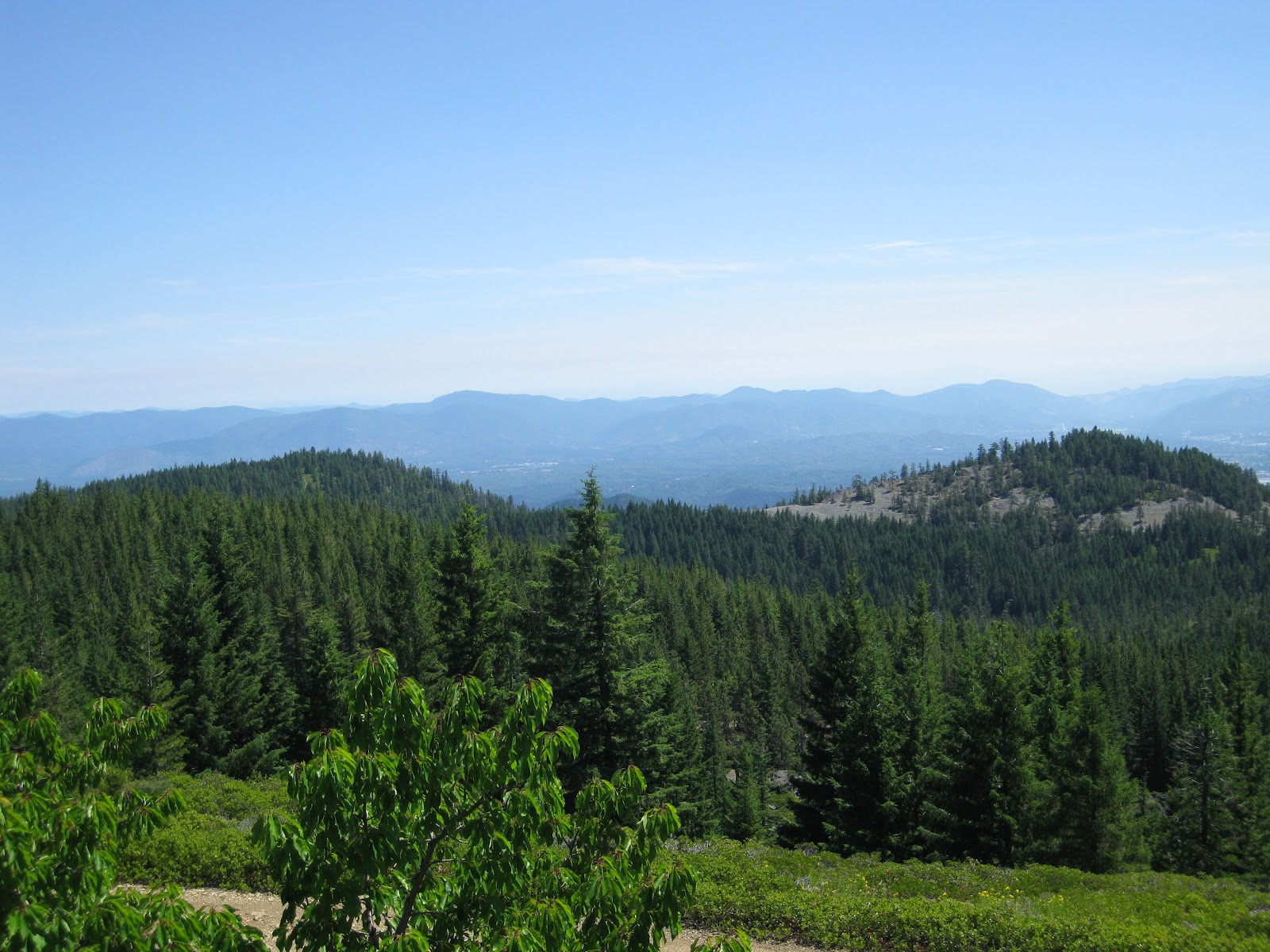
 The summit of Onion Mountain, with an elevation of 4,438 feet, offers panoramic views of the surrounding forests and mountains.

Other than a few small chipmunks and lizards, we didn't see much wildlife.

 One lone daylily.  I wonder who brought it up here?

 Only eight more years until this time capsule is scheduled to be opened.  It looks like someone has already tried, or maybe they were after the brass.

 It was the perfect day to sit in the sun and gaze out upon the countryside.

 Hiking up the road to the Onion Mountain Lookout tower are clumps of wild rosebushes.

A lovely view on the way up to the top.

At first glance, these plants looked like some type of succulent or even a mushroom.  I've got to say, these are the most unusual plant I have ever come across!

 After we got home, I had to find out more about these odd-looking plants.  Their common name is snow plant and they have no chlorophyll.  The scientific name is Sarcodes sanguinea Torr.  This name translates roughly from Latin to "the bloody flesh-like thing."  It was first described by botanist John Torrey in 1853.

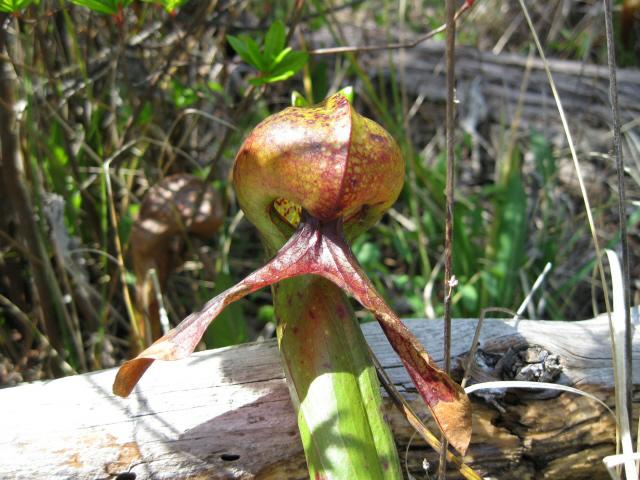
Another unusual plant, the Darlingtonia californica was also described in 1853 by John Torrey.  It is found in the Illinois Valley not too far from Onion Mountain.

Located in the Rogue River - Siskiyou National Forest, Onion Mountain is a short drive from Grants Pass or Cave Junction, but you probably won't have to share the trail with anyone else.

Friday, July 13, 2012

Tenth Anniversary of the Biscuit Fire - Josephine County, Oregon


 I was going to review the excellent book "The Big Burn" by Timothy Egan in this post, but there is already a wonderful book review by Tony Horwitz that was published in the New York Times on October 29, 2009.  Here's the link to that review: Wilderness Warriors.

Another review of "The Big Burn" that was published September 17, 2009 can be found at:  http://www.smithsonianmag.com/history-archaeology/Timothy-Egan-on-The-Big-Burn.html.

"The Big Burn" happened in 1910 and burned about three million acres; it is believed to be the largest fire in U.S. recorded history.  I highly recommend you read this book, both new and used copies can easily be found, and Amazon.com has a Kindle edition.

I would like to show you some pictures taken recently that still show the long-lasting scars of the Biscuit fire.  The "Biscuit Fire" burned 500,000 acres in the Siskiyou National Forest, and it started ten years ago today; July 13, 2002.


I find it both fascinating and terrifying that ten years ago, like now, was a very active fire season, with major fires burning in Colorado, Arizona and New Mexico.  Crews from the Pacific Northwest were busy fighting these blazes in other states when our forest caught fire. 

These photos were taken in the Kalmiopsis Wilderness along the Baby Foot Lake Ridge Trail.

It's been ten long years since the Biscuit Fire; small shrubs, oak and wildflowers are returning, but it still looks devastating.

 The Josephine County Historical Society has an electronic book on CD about the Biscuit fire by Charles R. Manfield available for purchase.  It's $25 and you can order it online at JoCoHistorical.org,
or in our Research Library at 512 SW 5th St, Grants Pass, OR.
The library hours are Tuesday-Friday from 10:00am to 4:00pm.

Monday, July 9, 2012

The Last Old West Train Robbery - Siskiyou Summit

Photo courtesy of http://www.livinggoldpress.com/SummitHotTopic.htm.

The following story is courtesy of Finn J.D. John - Offbeat Oregon

13 was unlucky number for train passengers, robbers alike

D'Autremont brothers destroyed mail car, killed several people in bungled attempt at a heist in 1923, in American history's last Old West-style train robbery.

One of the most dramatic events in Oregon state history took place on Oct. 11, 1923, in a railroad tunnel in southern Oregon.

It almost sounds like a Hollywood movie script. The train was the “No. 13 Gold Special,” heading from Seattle to San Francisco. In command was engineer Sidney Bates – and it was to be his last run; he was ready to retire and start drawing a nice pension. And at the fateful hour, the train was just cresting the Siskiyou summit and testing its brakes, getting ready to go through Tunnel 13.

When the train slowed down to test the brakes, three men jumped aboard. This was the d’Autremont brothers: 23-year-old twins Ray and Roy and their teenage brother, Hugh. They’d been planning a train robbery for months, and they’d heard a rumor that $500,000 worth of gold was aboard, so Train 13 seemed like a good one to hit. They’d stolen some dynamite from a construction site and, of course, they were armed with pistols. These, they pointed at Bates and ordered him to stop.

Bates stopped the train at the end of Tunnel 13. Back in the train, the passengers were not pleased – coal smoke was starting to leak into the cars. Up front, the brothers weren’t happy either. The mail clerk, who was actually covering someone else’s shift, barricaded himself inside the car, so the brothers packed their dynamite around the car and touched it off.

Unfortunately for everyone, they had no idea what they were doing, and the amount of dynamite they used utterly destroyed the car and killed the clerk instantly.

Meanwhile, passengers and crew members were trying to fight their way through the smoke and fire to the south end of the tunnel, but it was too intense. Finally, a brakeman, Coyle Johnson, managed to fight his way through – and was promptly gunned down by the robbers.

Likely realizing time was running out and there was no sign of money or gold, the brothers decided to get away while they could. So, they killed engineer Bates and the fireman, Marvin Seng, the only witnesses who had seen them; then they dipped their feet in creosote to throw the bloodhounds off the scent and fled.

They might have gotten away with the crime, except for Edward O. Heinrich, a detective brought in to work on the crime. Heinrich, looking over a pair of overalls left by the bandits, deduced from pitch stains on the garments that the wearer was likely a lumberjack, and from the wear patterns on the buttons, that he was left-handed. But the most damning thing he found was a crumpled-up old mail receipt in one of the pockets. He was able to track this right back to the brothers.

Ten days after the crime, Ray felt enough time had passed that he might hop a freight train to Ashland to do some shopping. Once he got there, he opened a newspaper over a cup of coffee in a diner – and saw his name in a headline. 

Of course, he raced right back to the hideout to tell the others the beans had been spilled. The brothers left the area, assumed new identities and started new lives – but four years later, the past caught up with them when Hugh, who had joined the Army, was fingerprinted.

All three drew life sentences. Hugh was paroled in 1959 and died a few months later; Roy, who’d been given a lobotomy in prison, also died just a few months after his parole in 1983. Ray, paroled in 1961, died in 1984, and spent many years working as a part-time janitor at the University of Oregon.

(Sources: Joers, Lawrence E.C. “The Siskiyou Train Robbery,” Great Moments in Oregon History. Portland: New Oregon Publishers, 1987 – a 6-page account by a physician who was aboard the train; http://ftp.wi.net/~maracon/lesson6.html; http://tunnel13.com; Sullivan, William L. Hiking Oregon’s History. Eugene: Navillus, 2006)

Thursday, July 5, 2012

Across the Wide and Lonesome Prairie - The Oregon Trail Diary of Hattie Campbell by Kristiana Gregory

Across the Wide and Lonesome Prairie by Kristiana Gregory is great fun to read.

It can best be described as "Little House on the Prairie" hits the Oregon Trail.

Although Across the Wide and Lonesome Prairie is a work of historical fiction, the landmarks exist, and many if not all of the experiences described, actually happened to our stalwart pioneers, many who were children, that came west using the Oregon, California and Mormon trails.

What a perfect gift to give a young lady for her 13th birthday!  Or for that matter, any girl or woman.  (Reading level is described as grades 3 through 7.)

Monday, July 2, 2012

The Billiard Table That Made Kerby - Kerby, Oregon

A couple of months ago I posted a story about how Kerby, Oregon was founded.  I thought it was a "tall tale," but it turns out it was based on a true story.

 Thanks to Kerby Jackson, well-known Southern Oregon author, historian, independent miner and mining rights advocate, I now have the original story.


It was written by Dennis H. Stovall and published in "Sunset Magazine" in 1903.

"On the stage road that leads its crooked way over the mountains from Crescent City, California, to Grants Pass, Oregon is Kerby, once known as Kerbyville.  Nestling at the foot of the pine-clad hills, with one long street, and overlooking the valley and the winding river, is this, the oldest mining camp in Oregon.

Kerby today is as quiet an old town as one would care to see.  But Kerby was not always asleep.  There was a time when Kerbyville was the gayest and thriftiest, and exchanged more "dust," than any other mining town north of San Francisco.  That was during the palmy and gold-fevered days of half a century ago.  Then the streets of Kerbyville seethed with the stampede of excited gold-hunters.  From a half score saloons issued day and night the boisterous merriment of reveling dancers, the clink of glasses and the monotonous hubbub of the faro tables.

Kerbyville, during those days, was in reality only a California mining camp moved over the Siskiyou range.  It was composed of the same stampede that swept across the plains during the excitement of '49.  A few miles below Kerbyville, on the Illinois, Josephine creek empties its waters into the larger stream, and it was here that gold was first discovered in the Oregon territory, April, 1851.  It was the news of this discovery that brought the living stream over the narrow trail of the Siskiyous and started swarms of men up every gulch and creek in southern Oregon.  Gold was discovered plentifully and miners flocked in by the hundreds.

Today, as the stage is borne along in a cloud of dust through the one long street, the traveler will see but a few scattered remains of the gay Kerbyville of fifty years ago.  The old courthouse is gone--for here was the first county seat of Josephine.  The old town hall still remains.  Farther on up the street is the jail.  It still stands, just as it stood forty years ago--a two-story, dark, gloomy structure, beneath the spreading branches of the entwining maple, whose limbs served as an ever-ready gallows for the popular "hangin's" of the rough and ready days.

Along the street are found the crumbling remains of the dance halls and stores.  The wind and the weather, the worms and the decay of half a century have done their work, and long since put many of these out of business.  The walls all lean toward the center, the windows are boarded up and a few scattered signs punctuated with the bullet marks of the old-timers' "six-guns," still cling desperately to the decaying walls.

Among the many saloons that once did duty in Kerbyville, only one remains.  In that one remaining "dewdrop" stands an old billiard table.  In outward appearance it is much like all other billiard tables, but in the matter of historic interest there is not another in the whole world that can equal it.  To that old table is due the honors of establishing Kerbyville.  It was the first brought into the state of Oregon, and, clustering about it are a multitude of historic associations more interesting, more fascinating than has ever befell a similar relic of the ivories and cue.

That old table, which seems to be tottering with age on its carved and crooked legs, was brought over the narrow and mountainous trail from Crescent City on the back of a pack mule.  Anita was the old mule's name.  She was the favorite pack animal of Martinez, a California and southern Oregon packer.  Martinez, or "Tig," as he was more familiarly known among the miners, was under contract to deliver the table to Althouse, a mining camp of the Illinois valley.  It was consigned to Jake Cohen, a saloonkeeper of the place.  The mule gave way beneath her great load when within eight miles of Althouse.  There was not another pack animal in the whole west that could stand up under the billiard table, so Tig was obliged to let it lay where Anita dropped it.  The old packer demanded his pay of Cohen.  The jew refused.  The table had not been delivered.  What the Mexican told the Hebrew wouldn't do to print.

At last a bright idea came into the head of Tig, the packer.  He built a saloon around the table, advertised a "grand opening" and got the stampede headed his way.  All of the miners of the Oregon country were there that night.  With the only billiard table north of San Francisco as a drawing card, the other Illinois valley camps were deserted.  The town became the leading mining camp of the Waldo hills.  In 1856 Kerbyville became the county seat of Josephine, which honored position she held during the palmy days.  From Eight-Dollar mountain, which stood sentinel at the valley's northern entrance, to the rising slopes of the snow-clad Siskiyous in the south, Kerbyville was supreme."