Tuesday, September 27, 2011

A Good Book


Some great quotes about books:

"Books are the quietest and most constant of friends; they are the most accessible and wisest of counselors, and the most patient of teachers."

 
Charles William Eliot - 21st President of Harvard University


"My test of a good novel is dreading to begin the last chapter.
"
Thomas Helm


"The man who does not read good books has no advantage over the man who can't read them."
Mark Twain


"You know you've read a good book when you turn the last page and feel a little as if you have lost a friend."
Paul Sweeney 


"Good books are to the young what the warming sun and refreshing rain of spring are to the seeds which have lain dormant in the frosts of winter."

Horace Mann


"It is what you read when you don't have to that determines what you will be when you can't help it."
Oscar Wilde


"The smallest bookstore still contains more ideas of worth than have been presented in the entire history of television."
  Andrew Ross


And, on a lighter note:

"Always read something that will make you look good if you die in the middle of it."
P.J. O'Rourke


"Outside of a dog, a book is man's best friend.  Inside of a dog it's too dark to read."
Groucho Marx
 

"There's nothing to match curling up with a good book when there's a repair job to be done around the house."
Joe Ryan

Monday, September 5, 2011

Mule Postman Loses Contract - Josephine County, Oregon

The following news story appeared in an out-of-state newspaper on September 5, 1947.

"Mule Postman Loses Contract In Remote Area
The lonely existence of the scattered families living in the remote fastness of Siskiyou national forest no longer will be relieved by periodic visits from the mule-driving postman.

The mule-pack postal route between the isolated towns of Illahe and Marial, near Grants Pass, has been terminated by the government because the carrier, who has a monopoly on mules, submitted too high a bid.

Residents of the remote mountain areas served by the mule routes do their shopping through the mail order catalogues and depend upon mule packs for everything--clothing, accordions, rifles, even food according to Fred H. Twohy, railroad mail district superintendent who has spent 10 years traveling the mountain regions to check on his mule postmen.

'One winter not even a horse could get through the heavy snows,' Twohy recalls.  'The residents were shut off from the world, and there was quite a squawk.'

Obliging postmen resorted to sleds to reach the isolated areas, Twohy adds, 'and the first thing people ordered by parcel post was several cases of beer.'

The Marial route was typical of the involved carrier setup required to get mail to secluded areas.  Mail went 34 miles up a river in a flat bottomed river boat from Wedder burn.  Then it was transferred to mule for an additional 16-mile trip.

It was 'kind of expensive,' Twohy admits, costing about $400 a person to keep the route open.  'The stamps don't begin to pay for it,' he adds.

'I have a hard time convincing them back in Washington that these routes are worth the expense,' Twohy says."

Wednesday, August 31, 2011

Herbert Hoover Pays Us A Visit

On August 31, 1926, it was reported that Herbert Hoover (then Secretary of Commerce) was fishing on the Rogue River.


Before entering the political arena, Herbert Hoover, our 31st President,  was a mining engineer and geologist.  In 1899 he was employed by a London-based mining company.  He worked at several different gold mines in Australia before going to China, where he served as the leading engineer.  

 In 1901 he was made a partner at Bewick, Moreing & Co.  After observing mining operations in New South Wales, he discovered a way to effectively to use the froth flotation process to recover zinc from tailings. 

With this type of background, it makes one wonder if he didn't also do a little gold prospecting while enjoying our magnificent Rogue River!

Wednesday, August 24, 2011

Man Pays Fine With Onions


The following is an excerpt from an article published August 24, 1933 in an out-of-state newspaper.

"'The fine is strong, but I guess you can stand it,' said the judge, penalizing V. O. Bishops for failing to stop his truck for a through street."

Mr. Bishops did not have the $5 to pay his fine, so the Josephine County judge agreed to accept 200 pounds of onions instead.

Monday, August 15, 2011

Teddy Roosevelt and Teddy Bears

No one can resist a cuddly Teddy bear.

Baby Mahto with his favorite teddy!
 In November of 1902 President Theodore Roosevelt was on a hunting trip in Mississippi.  One of his hunting companions had trapped a black bear cub and offered it to the President as an easy kill.  


Theodore Roosevelt refused the offer by saying, "What's the point of shooting an already trapped bear?"


A reporter for the Washington Post that had accompanied the hunting party, telegraphed the story back to his editor.  The Washington Post ran a cartoon of the story by showing a scene with the bear cub and the caption:  "Drawing the line in Mississippi."

 A hopeful toymaker from Brooklyn, New York, who had been trying to sell some toy bears made by his wife, saw the cartoon and had an inspiration.  He sent a letter to the White House asking Roosevelt's permission to use his name for his toy bears.  Roosevelt gave his permission, and Morris Michton started selling "Teddy's Bears" in his New York toy store.

They were a huge hit, and soon the name was shortened to the now very familiar "Teddy Bears."
photo of a "Teddy Bear" in the Steiff Museum Giengen Germany courtesy of Matthias Kabel.
Theodore Roosevelt didn't invent the "Teddy Bear," and who knows if he ever even owned one, but without his charisma and charm, we may still have toy bears, but not "Teddy Bears."

Happy First Birthday Mahto!

  Who can resist a Teddy Bear?

Tuesday, August 9, 2011

Diary Of A Mormon Missionary - Louisiana, December 1898

The following is a transcript from the diary of an LDS missionary from December 22, 1898.

"Girard, La             December 22nd 1898
Thursday
Stayed at Depot and occupied a bench which we laid on with quilt which the young man (the agent), gave us, but we did not sleep much, but were thankful for his kindness to us.  Elder Raymond wrote some Gospel letters to his friends, and after mailing them with some papers, we started out without any breakfast, expecting to go about eight miles south.  After walking down a short distance, ate some cake which Elder Raymond had on hand, it was very nice and so rich that we discovered two more pieces of silver in it making forty cents in all.  We then walked on our way.  I was not feeling well, stopped occasionally to rest short time.  We called at the home of Mr. John Young.  He invited us in, and the time was taken up in chatting and conversing upon the gospel until night having walked about 8 miles.  The weather was clear and warm for this time of year.  After eating supper, then conversed some time, sang a few songs and Elder Raymond read chapter in bible explaining the organization of the church.  Mr. Young and family are a going away to the southern part of this state in a short time to make them a new home with some other persons.  After speaking upon the way the church is organized, with Apostles, Seventy, Elders, Etc.  Then explained some other principles of the Gospel.  The day being passed again, all retired, after offering prayers with the family."


This LDS missionary was my great great grandfather Lewis Albert Warren.  He had just turned 32 years old, and was only six months into his mission.  He left a wife and six year-old son behind in Price, Utah.  Lewis Albert Warren was born in Spanish Fork, Utah and had never left Utah before starting on this mission.  


During this time, Mormon missionaries had to rely on "the kindness of strangers" to provide them with a place to sleep and food to eat.  This was usually done in exchange for sharing Mormon doctrine with the people they met, and helping out with chores.

It was not uncommon for my grandfather and his companion to walk many miles each day.  They were unaccustomed to the wet, humid weather of Louisiana, and it took its' toll.   Two months after this diary entry, Lewis Albert Warren had died from pneumonia.  

Monday, August 1, 2011

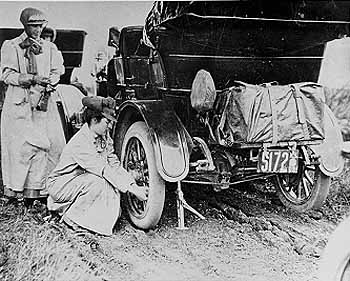
Alice's Road Trip - 1909

Alice Huyler Ramsey, with three companions in tow, arrived in San Francisco, CA on August 7, 1909.

 22 year-old Alice, accompanied by her two "forty something" sisters-in-law, and a 16 year-old friend was the first woman to drive across the United States.

It was originally meant as a publicity stunt for the Maxwell-Briscoe auto maker, but it turned into a step forward for women.

These four ladies left Hell's Gate in Manhattan on June 9, 1909 in a Maxwell 30, and set off on a 3,800 mile journey, of which only 152 miles were paved!  The route they took would later be named the "Lincoln Highway."

Alice Ramsey was the only one of the four women that knew how to drive.  Her husband had bought her a car the summer before, and she wasted no time in putting 6,000 miles on that car.

Over the course of the 59 days, the ladies learned how to change tires, clean spark plugs and to check the fuel level.  They ran out of gas in the Midwest after forgetting to check the tank before they left one morning.  To check the Maxwell's fuel level, you had to remove the front seat cushion, and insert ruler into the fuel tank.
The next day, their engine overheated and they didn't have any water with them.  Nettie Powell and Margaret Atwood, Alice's sisters-in-law found the solution.  They used their sterling silver and cut-glass toiletries holders to bring water, an ounce at a time, from road-side ditches to refill the radiator.


While traveling through Nebraska, the adventuresses were surrounded by a group of Native Americans with bows and arrows, but quickly found out they were just hunting rabbits.  

 In Wyoming they were stopped by men on horseback, who turned out to be a posse on the trail of a murderer. 

During her driving career Alice Huyler Ramsey would make this cross-country trek more than 30 times.  She was on her way to have driven all six passes of the Swiss Alps, when her doctors forced her to not drive the final pass because of her pacemaker.  Alice died at the age of 96 on October 9, 1983.

Finally, on October 17, 2000, Alice was the first woman to be inducted into the Automobile Hall of Fame.  It sure took them long enough!

A first-hand account of Alice's adventure, can be read in her book "Veil, Duster, and Tire Iron," which was published in 1961.
 
By 1909, only a handful of men had successfully completed the journey of driving a car across the county; the first time was only six years prior, in 1903, by Dr. Horatio Nelson.

As for the Maxwell-Briscoe company, it did not experience the longevity that Alice Huyler Ramsey enjoyed.  The company was absorbed by Chrysler in 1926.