My dad sent this to me last week, and I recognize some of the phrases, but there were a few I hadn't heard before.

Thanks Dad! |
Friday, June 24, 2011
A Lick And A Promise... What on earth does that mean?


Monday, June 20, 2011
Letters Of A Woman Homesteader - by Elinore Pruitt Stewart
"Burnt Fork, Wyoming, April 18, 1909
Dear Mrs. Coney, -
Are you thinking I am lost, like the Babes in the Wood? Well, I am not and I'm sure the robins would have the time of their lives getting leaves to cover me out here. I am 'way up close to the Forest Reserve of Utah, within half a mile of the line, sixty miles from the railroad. I was twenty-four hours on the train and two days on the stage, and oh, those two days! The snow was just beginning to melt and the mud was about the worst I had ever heard of.
The first stage we tackled was just about as rickety as it could very well be and I had to sit with the driver, who was a Mormon and so handsome that I was not a bit offended when he insisted on making love all the way, especially after he told me that he was a widower Mormon. But, of course, as I had no chaperone I looked very fierce (not that that was very difficult with the wind and mud as allies) and told him my actual opinion of Mormons in general and particular.
Meantime my new employer, Mr. Stewart, sat upon a stack of baggage and was dreadfully concerned about something he calls his "Tookie," but I am unable to tell you what that is. The road, being so muddy, was full of ruts and the stage acted as if it had the hiccoughs and made us all talk as though we were affected in the same way."
These are the first paragraphs of "Letters Of A Woman Homesteader" by Elinore Pruitt Stewart. This book is a collection of letters Mrs. Stewart wrote to a former employer over several years.
 | ||||
| 1825 Burnt Fork, Wyoming |
Elinore Pruitt's husband died from a railroad accident, forcing her to find work to support herself and her little girl. After spending time in Denver working as a housecleaner and laundress, she wanted a better life for herself. She set out for Wyoming where homesteaded land could be purchased for $1.25 an acre!

Elinore was only 29 upon her arrival in Burnt Fork, Wyoming; but she was so tenacious and hard-working that she couldn't help but succeed! This collection of letters show her to be an adventurous, witty and thoroughly delightful woman!

"Letter Of A Woman Homesteader" was first published in 1914, and is still fascinating to read almost 100 years later. I was engrossed from the first few paragraphs, and couldn't wait to read about her next adventure.
Friday, June 17, 2011
"Don't Fire Until You See the Whites of Their Eyes"
The quote "Don't fire until you see the whites of their eyes" was uttered by either American Colonel William Prescott or Major General Israel Putnam during the Battle of Bunker Hill. Because gunpowder was so scarce, it was important that every shot fired counted.
 |
| Major General Israel Putnam |
The Battle of Bunker Hill was the first large battle during the American Revolution. It was fought on June 17, 1775, and most of the battle took place on nearby Breed's Hill.

This is an image of an oil on canvas by John Trumbull; depicting the death of Major General Joseph Warren at the Battle of Bunker Hill.
Colonel Prescott and Major General Putnam had asked that Joseph Warren be their commander. Warren turned down the offer to command and volunteered to serve as a private, since both Prescott and Putnam were more experienced with war.
This oil painting is now displayed in the Museum of Fine Arts in Boston, Massachusetts.
Tuesday, June 14, 2011
Why We Celebrate Flag Day
Flag Day, June 14, is the anniversary of the day on which the Continental Congress formally adopted the Stars and Stripes as the flag of the United States in 1777. Americans have been observing this day since 1897.
 |
| This flag was in use from June 14, 1777 to May 1, 1795 |
President Woodrow Wilson proclaimed officially that June 14 is flag day. In August of 1949 National Flag Day was established by an act of congress.
Flag day is not an official holiday, but it is important to all good Americans.

There is a story about Theodore Roosevelt and flag day that goes like this; On June 14, 1908, "Theodore Roosevelt was dining outside Philadelphia, when he noticed a man wiping his nose with what he thought was the American Flag. In outrage, Roosevelt picked up a small wooden rod and began to whip the man for 'defacing the symbol of America.' After about five or six strong whacks, he noticed that the man was not wiping his nose with a flag, but with a blue handkerchief with white stars. Upon realization of this, he apologized to the man, but hit him once more for making him 'riled up with national pride.'"
The following are lines from the poem, "The American Flag" written by Joseph Rodman Drake in 1819:
When Freedom, from her mountain height,
Unfurled her standard to the air,
She tore the azure robe of night,
And set the stars of glory there!
She mingled with its gorgeous dyes
The milky baldric of the skies,
And striped its pure celestial white
With streakings of the morning light,
Then, from his mansion in the sun,
She called her eagle-bearer down,
And gave into his mighty hand
The symbol of her chosen land!

Thursday, June 9, 2011
One For Sorrow (nursery rhyme)
- "One for sorrow
- Two for joy
- Three for a girl
- Four for a boy
- Five for silver
- Six for gold
- Seven for a secret, never to be told
- Eight for a wish
- Nine for a kiss
- Ten for a bird you must not miss"
- The above is a traditional English nursery rhyme about magpies. There are many variations of lyrics, but these I have quoted are the most modern version.
- One of the earliest versions, published in about 1840, is:
- "One for sorrow,
- Two for luck; (or mirth)
- Three for a wedding,
- Four for death; (or birth)
- Five for silver,
- Six for gold;
- Seven for a secret,
- Not to be told;
- Eight for heaven,
- Nine for [hell]
- And ten for the d[evi]l's own sell!"
- According to superstition, the number of magpies you see determines what kind of luck you will have.
- In the United States, where magpies aren't as common as they are in Britain, crows, bluebirds and jackdaws are sometimes associated with the rhyme.
- In the 1989 film "Signs of Life," the rhyme was used for counting crows.
- The band Counting Crows took their name from the "Signs of Life" version, and they use the rhyme in their song "A Murder of One."
- We have a family of five crows that spend hours in our backyard every day of the year; I wonder if it is a portent, or if they just like the birdseed I provide?


Monday, June 6, 2011
Library Offer Declined by Grants Pass City Council
In view of the economic problems that the Josephine Community Libraries is currently experiencing in regards to keeping the local libraries open, I found this a very interesting article. It was published November 14, 1903 in an out of state newspaper.
"DECLINED WITH THANKS
Grant's Pass, Ore., Nov. 13. --- After five months of debate and consideration the council of Grant's Pass has decided to decline the offer of $10,000, made by Andrew Carnegie for a library for the city. The city council did not approve of certain stipulations attached to the offer of the steel king."
I haven't been able to discover exactly why the city council turned this offer down, but some of the requirements to receive a Carnegie grant were:
- demonstrate the need for a public library;
- provide the building site;
- annually provide ten percent of the cost of the library's construction to support its operation; and,
- provide free service to all.
1,687 Carnegie libraries were built in the United States between 1888 and 1923. When the final Carnegie grant was made, nearly half of the 3,500 libraries in the United States were built with Carnegie construction grants.
 | |
| Image courtesy of Lee Paxton. |
This is a photo of the Carnegie Free Library in Braddock, PA. It was built in 1888, and was the first Carnegie Library in the United States.
Before there were Carnegie libraries, you could not browse among the stacks of books; you had to ask a librarian to retrieve a book for you!
The Josephine Community Library system is a nonprofit organization. They do not have any no local or federal tax funding! Like the Josephine County Historical Society, they rely completely on contributions and volunteers.
As a kid, I spent countless hours at my public library, and I hope that the children (and adults) of Josephine County will always have access to a library! For more information, please visit the Josephine Community Libraries website.
Thursday, June 2, 2011
Karuk Tribe Members Enroll in Redwood Highway Marathon
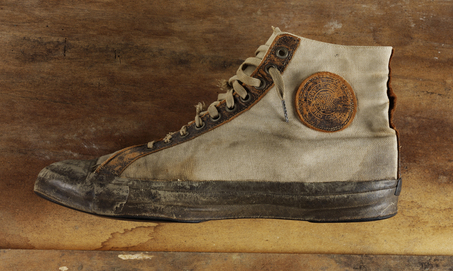
The following is an Associated Press release dated June 2, 1927:
"Grants Pass, Ore., --Eight runners of the Karuk tribe of the lower Klamath region are in training here for the longest marathon on record to be run over the Redwood highway from San Francisco to Grants Pass, starting June 14th.
The runners are under direction of two trainers and are working out daily over paved highways near this city to get used to the type of road to be encountered on their long jaunt. Camp has been established in the city park. Tribal names of the runners are Flying Cloud, Mad Bull, Fighting Stag, Rushing Water, Thunder Cloud, Big White Deer, Sweek (Eagle) and Falcon.
The eight will run under the colors of the Oregon cavemen."
The news story fails to mention that this grueling marathon was 480 miles long! The "Redwood Marathons" were run in 1927 and 1928 to advertise the opening of the Redwood Highway.
The eight Karuk Tribe members were from counties along the Redwood Highway and there were also three Zuni Tribe members from Gallup, New Mexico.
 |
| Photo courtesy of Bob Lee and the Redwood Empire Association. |
Johnny Southard (Mad Bull) won the 1927 Redwood Marathon when he crossed the finish line in Grants Pass after seven days, 12 hours and 34 minutes. The grand prize was $1,000 in gold. One of the runners from New Mexico was reportedly in his late 50's. In 1928 there were 29 men who entered the race; Henry Thomas (Flying Cloud) was the winner, and he took home the prize of $5,000.
You can read a full account of these marathons in the book "Golden Memories of the Redwood Empire" at Google books: Redwood Marathons
Subscribe to:
Posts (Atom)